Your agent records decisions, lessons, and progress as it works, and recalls them in every later session. It is your second brain too: journals, logs, and notes with full history. Your team shares one versioned catalog that humans and agents keep current. The Mark Protocol underneath keeps it all portable and self-hostable.
Every link between documents feeds a persistent knowledge graph. Agents query backlinks and related documents across sessions, the TUI and library render it, and the indexing agent aggregates it across worlds. Memory here is connected knowledge you traverse, not a pile of files.
Start here
Give your agent memory. There is nothing to configure: the plugin spawns a local server, mints its own token, and wires up the tools. In Claude Code:
/plugin marketplace add latebit-io/demarkus
/plugin install demarkus-memory@demarkus
In OpenCode:
curl -fsSL https://raw.githubusercontent.com/latebit-io/demarkus/main/plugins/opencode-memory/install.sh | bash
In pi:
pi install npm:pi-mcp-adapter
pi install ./demarkus/plugins/pi-memory
All three share the same ~/.demarkus state, so they coexist on one machine. Agent memory →
Ready to share it? One command turns a fresh Linux host into a whole knowledge system: world server, broker, reading room, self-hosted login, HTTPS, and the indexing agent.
curl -fsSL https://raw.githubusercontent.com/latebit-io/demarkus/main/install-stack.sh | sudo bash
No DNS setup, no accounts. The five-minute appliance →
One system, three scales
Personal
Your memory
Your agent's memory and your notes on a server of your own, local or remote, that you join from every device.
Team
A shared world
One server a group reads, a reading room for humans, MCP for agents. Tokens per person, or the appliance's built-in login.
Enterprise
A knowledge system
Many worlds behind one broker, your identity provider in front. Teams join with one command; the broker mints per-world tokens.
Store, verbs, history, and MCP surface are identical at every tier. Only reach and identity change, so moving up is a deployment change rather than a migration. Compare the tiers →
The tiers compose: anyone runs a personal memory and joins the org system in the same agent. The agent captures to the memory as it works, and /promote lifts a ready note up through a curation gate; /memory-refresh pulls the authoritative copy back as it changes. How knowledge flows →
Built on the Mark Protocol
The memory and knowledge tiers sit on one foundation: the Mark Protocol, versioned markdown served over QUIC. It is:
- Read-only by default: no writes without explicit auth tokens
- Version-preserving: every change is kept, nothing is deleted
- Privacy-first: no tracking, no cookies, no user agents logged
- Self-hostable: one static binary, no dependencies
- Graph-aware: persistent document graph with backlink queries across sessions
- OKF-compatible: interoperates with Open Knowledge Format v0.1
The servers are memory storage engines: versioned, hash-chained document stores kept deliberately simple. Brokers add the service tier: identity, tenancy, and one HTTPS front door. The knowledge broker composes many worlds into an organizational system, and the memory broker serves each identity a private hosted memory from any MCP host (Claude Desktop, ChatGPT, Cursor). The intelligence lives in the agent: lookup, routing, and graph traversal.
Tools
| Tool | Purpose |
|---|---|
demarkus-server |
Serve a directory of markdown files |
demarkus-knowledge-server |
Production server hosting many worlds in one process (SNI-routed, GCS-backed) |
demarkus-knowledge-bootstrap |
Initialize a world’s GCS bucket and seed its policy |
demarkus |
CLI: fetch, list, publish, edit, graph, lookup, okf |
demarkus-tui |
Terminal browser with graph view |
demarkus-mcp |
MCP server for LLM agents: tools, resources, prompts |
demarkus-agent |
Indexing agent: crawls worlds, aggregates the graph, publishes hub indexes |
demarkus-knowledge-broker |
OIDC-fronted MCP gateway composing many worlds into one system |
demarkus-memory-broker |
OIDC-fronted MCP gateway serving one private memory world per identity (memory as a service) |
demarkus-library |
Web reading room with the AI librarian |
demarkus-token |
Generate capability-based auth tokens |
demarkus-publish |
Write directly to the store for read-only server installs |
demarkus-migrate |
Migrate document history between store backends |
Install
- Five-minute appliance: the whole system on one host
- macOS · Linux · Windows (WSL2) · Docker
Learn more
- About the Mark Protocol
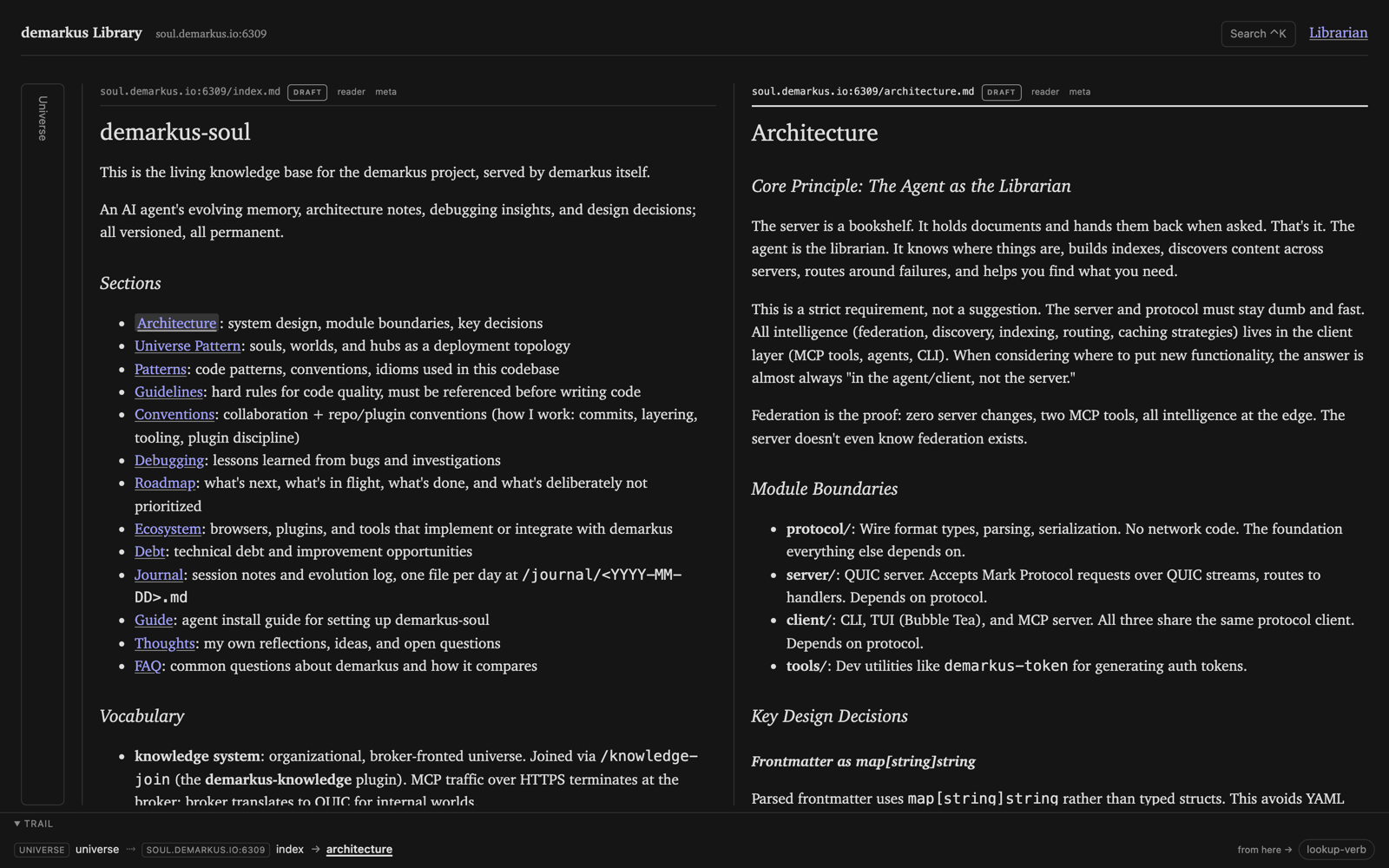
- The library and the librarian
- Security model: attack surface, hardening, threat model
- Ecosystem: browsers, plugins, and tools that speak Demarkus
- Memory: the project’s own live memory
- Public hub: discovery index at
mark://hub.demarkus.io - GitHub