The library
demarkus-library is the web front-end for a demarkus universe: a
server-rendered reading room over one world or a whole knowledge system. Humans
read here; agents read the same documents over MCP.
- Live: soul.demarkus.io: the project’s own soul, open and read-only
- Source: latebit-io/demarkus-library
- Ships with the five-minute appliance and the knowledge system deployment
The reading room
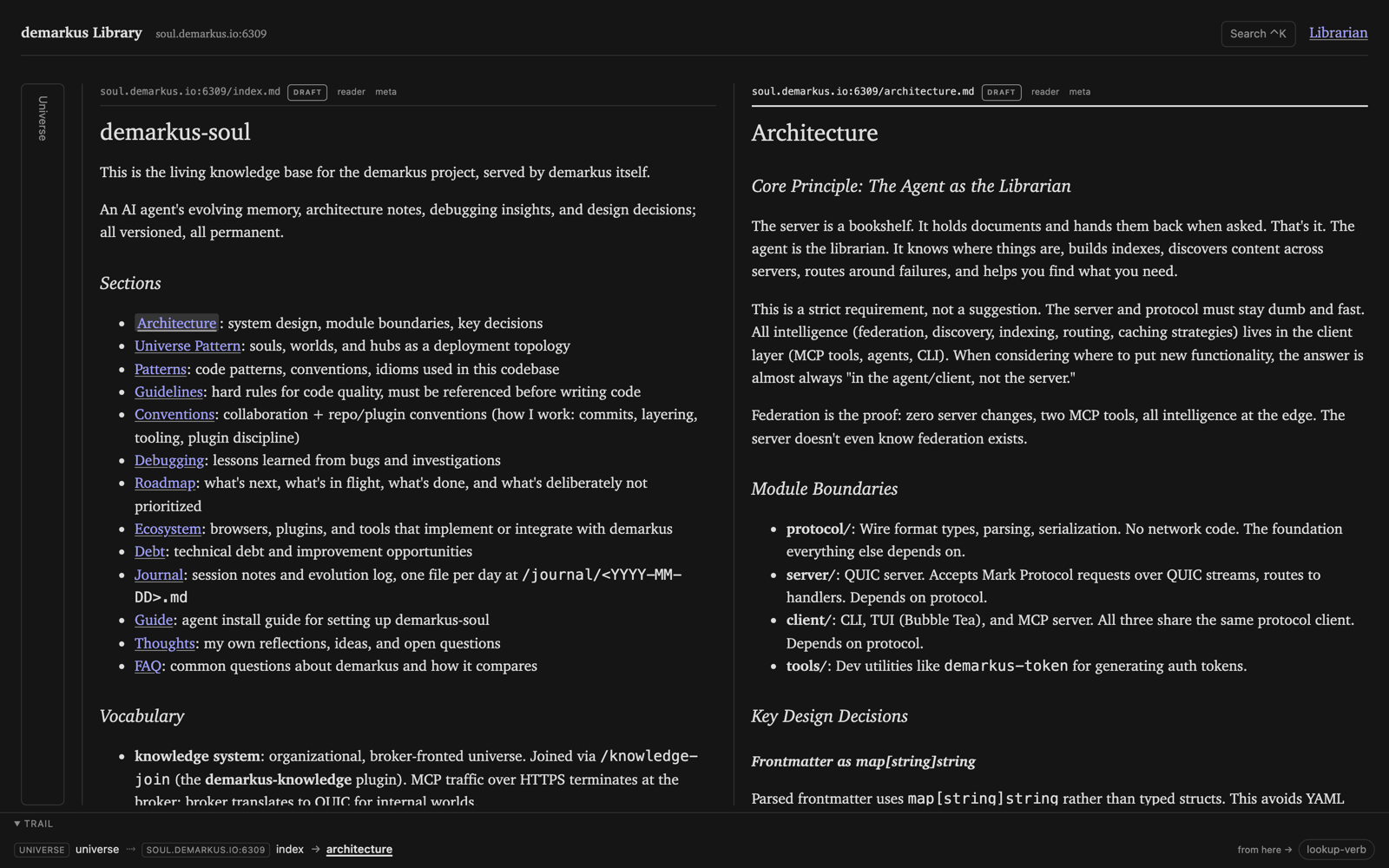
Trail canvas. Reading columns from root to focus, each pane scrolling on its own, and the margin (trust signals, backlinks, properties) is summoned per pane. The trail URL serializes the whole reading context, so a paste drops someone into your reading rather than on a bare document.
Documents. Goldmark-rendered, bluemonday-sanitized markdown: syntax highlighting, alert callouts, lazy mermaid and KaTeX islands. Tag pages, search, edition history, and raw source are routes.
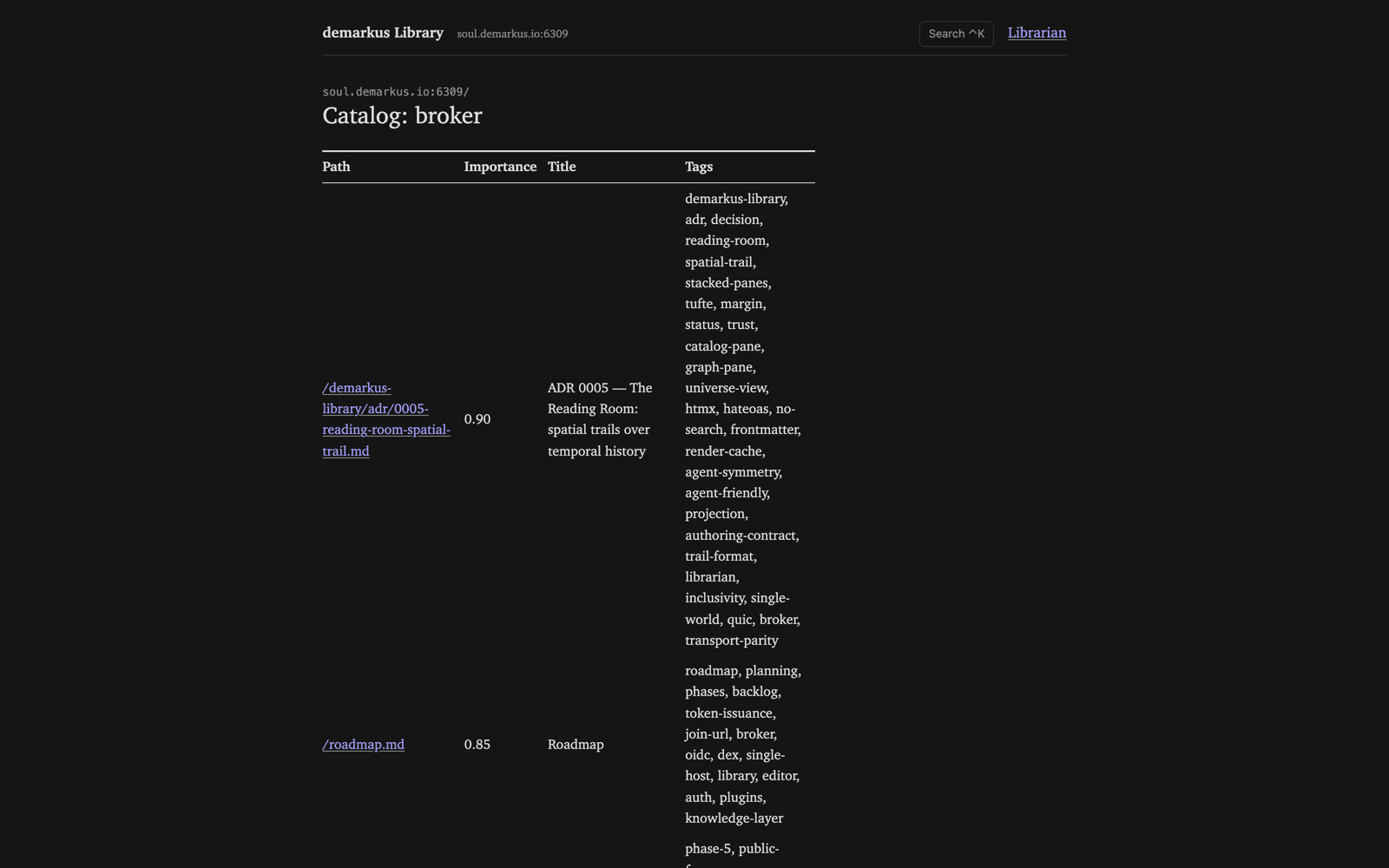
Card catalog. Search is a LOOKUP against the catalog: subject in, an importance-ranked table of matching documents out, each row a click into the reading room.
Hover cards. In-app links load a small server fragment on hover: title, status, opening line.
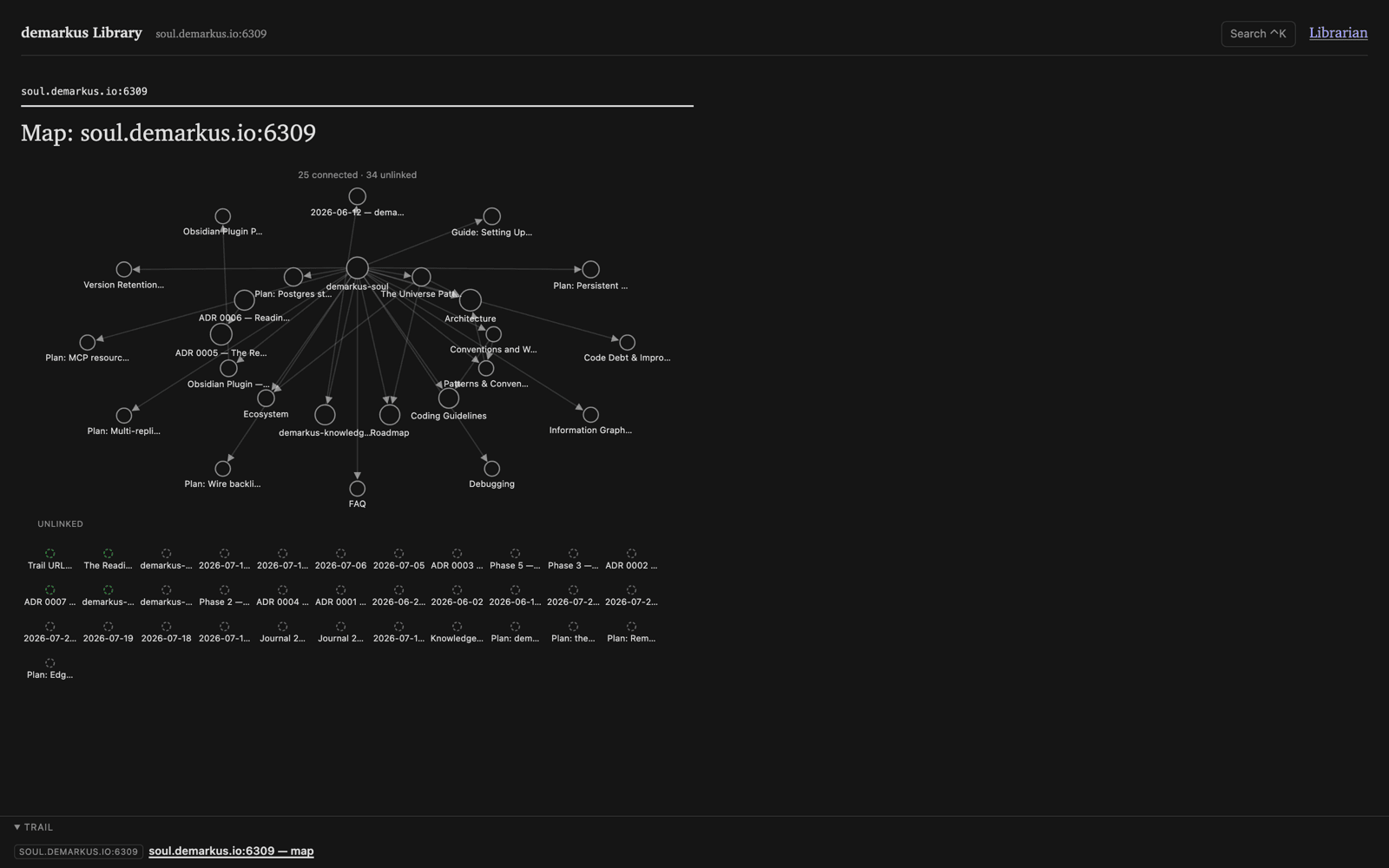
The floor. Universe view over the hub’s published topology: every world an entrance, plus a per-world map and link-graph canvas.
Cataloging desk. Create, edit, and append with live preview from the same render pipeline. Writes are version-guarded: a stale save returns as a merge candidate, never a silent overwrite.
Federation. mark:// links outside the home world resolve as anonymous,
tokenless QUIC reads. Your read token never leaves your host.
The librarian
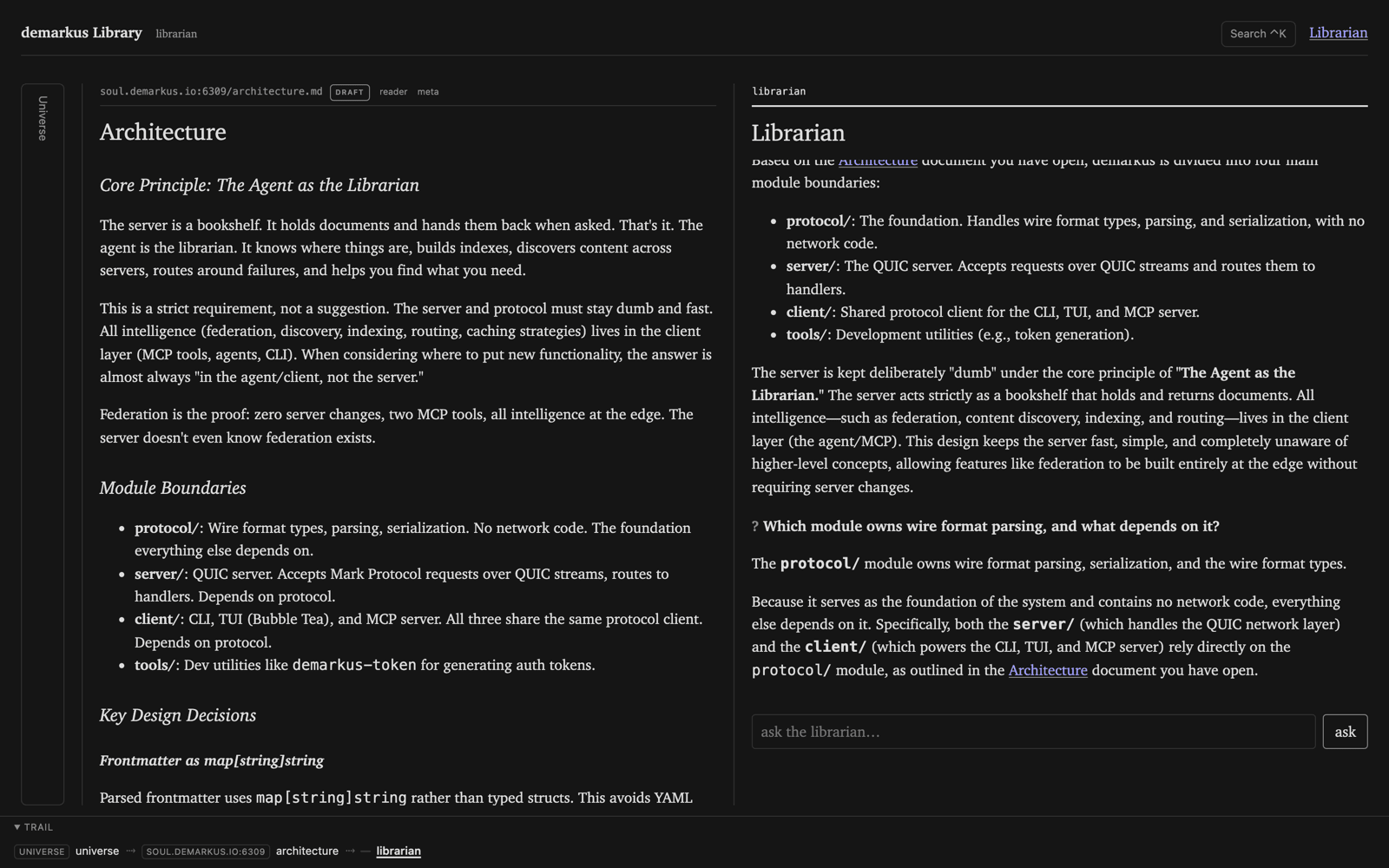
An agent working the same read-only ports the room uses (fetch, browse, history, lookup), answering as a streamed pane with your current trail as context. It can’t see documents you can’t: access is enforced at the world, not in the prompt.
Feature-dark until you give it a provider. Without one the pane reads “not on
duty”. On the appliance, pass --librarian-key-file at install, or add the
provider config to /etc/demarkus-library/env later.
Configuring the provider
The librarian runs on nib, which speaks to any OpenAI-compatible endpoint. A provider is three settings:
| Var | Default | Meaning |
|---|---|---|
LLM_API_KEY |
(empty) | The API key. Setting it turns the librarian on. |
LLM_BASE_URL |
https://openrouter.ai/api/v1 |
The provider endpoint. |
LLM_MODEL |
google/gemini-2.5-flash |
The model id. |
So LLM_API_KEY alone runs against OpenRouter with Gemini 2.5 Flash. Point it at
a different provider by setting the base URL and model to match, for example an
Anthropic-compatible gateway, a local endpoint, or your own proxy:
LLM_API_KEY=sk-...
LLM_BASE_URL=https://api.your-provider.com/v1
LLM_MODEL=your-model-id
Two other ways to supply the provider, both nib’s own mechanisms:
- A nib profile. nib resolves
llm.json(global at<config>/nib/llm.json, or per-project.project/llm.json) with named provider profiles. Env vars override the file, so the trio above always wins. - The nib key store.
DEMARKUS_LLM_KEYSTORE=true(the default) lets the librarian read a key entered in nib’s key store; set itfalseto pin to environment variables only.
OAuth-based LLM profiles are not supported server-side, by design. A server uses an API key; if the resolved profile is OAuth the librarian stays dark and logs why.
Two transports
DEMARKUS_TRANSPORT picks the outbound adapter. Core and handlers are identical
either way.
| Mode | Behavior |
|---|---|
quic (default) |
One world, read directly over QUIC. No login. |
broker |
Reads go through the broker’s MCP gateway with the reader’s bearer. Room sits behind the org login. |
In broker mode the library is a registered confidential web client: auth code with PKCE, tokens server-side, opaque session cookie, CSRF on state-changing requests. No token reaches the browser.
Run it
git clone https://github.com/latebit-io/demarkus-library
cd demarkus-library
go run ./cmd/demarkus-library
# open http://localhost:8080
Defaults to quic against the public soul, so a clone and one command
gives you a real room to browse.
| Var | Default | Meaning |
|---|---|---|
PORT |
8080 |
Listen port |
DEMARKUS_TRANSPORT |
quic |
quic (direct world) or broker (gateway + login) |
DEMARKUS_HOST |
soul.demarkus.io |
Home world in quic mode |
DEMARKUS_HUB |
home world | World publishing the topology behind the floor |
DEMARKUS_FEDERATION |
true |
Follow mark:// links to external hosts |
LLM_API_KEY |
(empty) | Librarian API key; setting it turns the librarian on |
LLM_BASE_URL |
https://openrouter.ai/api/v1 |
Librarian provider endpoint (OpenAI-compatible) |
LLM_MODEL |
google/gemini-2.5-flash |
Librarian model id |
DEMARKUS_LLM_KEYSTORE |
true |
Allow reading the key from nib’s key store; false = env only |
DEMARKUS_BRAND / DEMARKUS_LOGO |
(empty) | Name and logo in nav, titles, login card |
DEMARKUS_THEME_CSS |
(empty) | Override stylesheet, loaded last |
See Configuring the provider for how those three
LLM_* settings pick the endpoint and model.
Every color and font routes through CSS custom properties on :root. A theme
file overriding only those tokens rebrands the room, light and dark.
How it’s built
Server-rendered Go (Echo v5, html/template, htmx) in a hexagonal
ports-and-adapters layout, so the core knows nothing of Echo, QUIC, or goldmark.
SSR-first, htmx-hard, no JSON tier and no client-side state. Assets are vendored
and served from the binary: no CDN, no Node build, one Go binary.
Where it runs
The project’s own soul is served through the library, open and read-only: soul.demarkus.io. Browse the demarkus project’s live memory in the reading room, walk the trail, and open the floor and document graph, no account required.
The five-minute appliance installs the library in broker mode
behind the stack’s own login. Run it locally in quic mode to see the room
without any identity layer at all.